Individual Therapy
You already know more than you think you do. You have likely spent years trying to understand yourself through your thoughts.
Individual therapy at The Ritual Practice Place is for women who are perceptive, capable, and deeply aware—and want support turning that awareness into an embodied trust they can actually live from.
For Those Becoming More Themselves
You may already understand yourself exceptionally well.
You know why you overthink. Why you anticipate. Why you brace. Why you find yourself monitoring other people's needs, reactions, expectations, or emotions.
You may have language for attachment, trauma, anxiety, perfectionism, masking, people-pleasing, or the nervous system.
And still, understanding something is different from being able to trust yourself while it is happening.
Our work is interested in that gap.
Not simply knowing yourself, but becoming able to live from what you know.
What We Notice Together
The body gets a say. Somatic work invites us to notice the body before immediately explaining or correcting it.
Sensation, posture, breath, tension, movement, numbness, pleasure, anger, and instinct offer information about what your system expects, protects, wants, and remembers.
We aren't using the body simply to become calmer.
We use it to develop attunement.
What happens when you imagine saying yes? What changes when you imagine saying no? Where do you brace when you anticipate being seen? What happens when your body is allowed to receive support?
Over time, these experiences create embodied evidence that you can hear yourself, respond to what you find, and trust yourself through uncertainty.
Continue Exploring
There are questions beneath this practice that I continue to follow.
Questions about the body and spirit, attachment and belonging, the worlds we adapt ourselves to, and what it means to become more fully ourselves without treating ourselves as problems to solve.
If you are curious about the ideas that shape how I understand therapy—or simply want somewhere to wander before deciding whether this work is for you—I write about them in On Being Here.
Follow the questions →
Therapy is one place this work can happen. My writing is another.
These collections explore the questions that move throughout The Ritual Practice Place: how we inhabit our bodies, trust what we know, live with integrity, remain sovereign in relationship, receive what is available to us, and build lives large enough to hold who we are becoming.
Read slowly. Take what belongs. Leave what doesn't. Return when something changes.
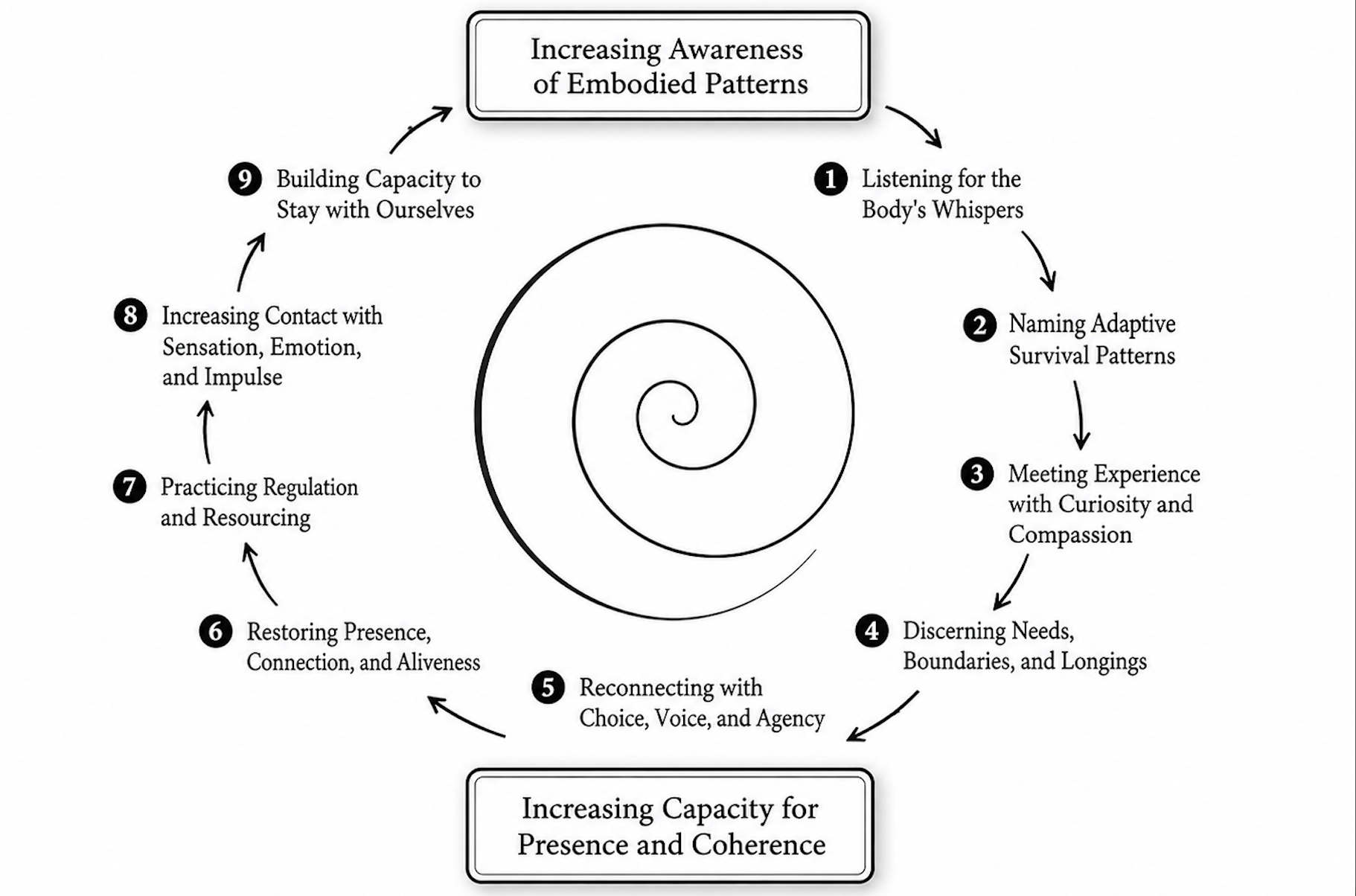
The Ritual Practice Place Model
What We Work With
-
When does your breath become shallow?
Can your back body receive an inhale?
What changes when your exhale slows?
-
What happens to your shoulders when you're overwhelmed?
Where do you grip?
Where do you collapse?
What changes when your body feels supported?
-
Does your body want to pace?
Become still?
Shake?
Stretch?
Press into the ground?
Curl inward?
Every impulse offers information.
-
When do your eyes begin scanning?
When do they soften?
What helps you feel present?
-
When do you feel activated?
When do you feel depleted?
How do you know you've crossed your own limits?
Can you recognize your needs before your body has to shout?
-
How does your body change around different people?
When do you become smaller?
When do you hold your breath?
When do you finally feel like yourself?
What Therapy Can Feel Like
There isn't one right way to heal.
Some sessions involve conversation.
Some involve silence.
Some involve noticing how your feet meet the floor.
Others may include breath, movement, imagery, parts work, or simply becoming curious about a sensation that has been asking for your attention.
Together, we develop a language that belongs to your body—not a script borrowed from someone else's healing.
-
I draw from attachment theory, somatic awareness, parts work, and relational psychotherapy to help you better understand the patterns that shape your life.
Rather than trying to eliminate anxiety, numb difficult emotions, or force yourself into a state of calm, we'll explore what these experiences might be protecting and how your body has learned to care for you over time.
The goal isn't to become someone different.
It's to develop a relationship with yourself that is rooted in curiosity, compassion, and choice.
-
You may begin to notice things sooner.
The tension before burnout.
The breath you've been holding.
The moment your shoulders lift.
The hunger you usually ignore.
The part of you that is trying to protect something tender.
These moments become opportunities—not because you've learned to control your nervous system, but because you've learned to listen to it.
-
Therapy isn't something that happens to you.
It's something we practice together.
While I believe deeply in making space for your experience, I also believe in offering guidance, perspective, and practical tools when they can help move the work forward.
My role isn't to sit silently while you figure everything out alone. It's to bring my training, experience, curiosity, and presence into relationship with you.
Sometimes that means helping you notice patterns you've never seen before.
Sometimes it means gently challenging a belief that no longer serves you.
Sometimes it means slowing down enough to listen to your body.
Other times, it means helping you build concrete skills that you can take with you long after our session ends.
Throughout our work together, I'm committed to creating a relationship that is thoughtful, collaborative, and compassionate—one where you feel supported, challenged when needed, and respected as the expert on your own life.
My hope is that therapy doesn't simply become a place where you feel understood.
I hope it becomes a place where you begin understanding yourself.
-
I will bring my full attention to our work together.
I will listen not only to your words, but to the ways your body, relationships, and history have shaped how you move through the world.
I'll offer observations when I notice patterns.
I'll ask questions that invite deeper reflection.
I'll share knowledge when understanding can create more choice.
I'll offer practices and skills when they feel supportive.
I'll challenge you with kindness when I believe you're capable of taking another step.
I'll celebrate your growth, sit with your grief, and help you return to yourself when life pulls you away.
I don't believe healing comes from having all the answers.
I believe it comes from developing a relationship with yourself that is grounded in awareness, compassion, and practice.
My commitment is to walk alongside you with warmth, honesty, and direction—bringing both my clinical expertise and my humanity into the room—so that over time, you need me less because you've learned to trust yourself more.